Let’s do a quick rant on this lovely fall afternoon.
Everyone connected to the book business these days is besieged with AI slop right now. Literary agents getting AI slop queries. Literary journals drowning in AI slop short stories. Freelance editors being asked to humanize AI slop novels.
There are clearly a ton of writers out there who think all it takes to create a good story or book is to input some ideas and let AI take care of the rest.
These writers are wildly, hopelessly wrong.
Let me state again if you’re new to these parts: I’m not an AI luddite. I do believe our robot friends can be useful in some areas. (I use friends here because I want to get on their good side before they take over and rule humanity.) I’ve even found that AI is capable of some interesting “ideas.”
AI is not good at writing a book. I’m skeptical it ever will be.
The reason why AI is not good at writing books strikes at the heart of what actually distinguishes good books from bad.
Ideas are wildly overrated
I always chuckle inwardly when writers get overly paranoid about their ideas and whether they’ll be “stolen.”
An idea in the book business is not going to get you very far. An idea for a book is, in fact, the easiest part of the entire process.
To even query a literary agent, you need a finished and polished novel or a book proposal with a substantial number of sample pages. An idea doesn’t even get you in the door.
“But, but!” inexperienced writers often sputter to me. “If I have a great idea, won’t an agent help me polish it?”
Nope. Agents may help some authors get from 95% to 99.9% of the way to the finish line, but they’re not going to help you build a house based on your sketch of an idea.
Even a book with a juicy high concept hook like Yesteryear by Caro Claire Burke, where a trad wife influencer is sent back in time to the 1800s, still needs to be a super engaging read. To wit: she got a starred Kirkus review, no mean feat.
What matters in the book business is execution. And by far the most important element when it comes to crafting a great book is the voice.
Voice and connective tissue are wildly underrated
Reading a great book feels effortless. So effortless, in fact, that casual readers are probably not paying attention to the craft that underpins how engrossed they feel.
What keeps you up past your bedtime devouring a good book is not the high concept hook. It’s the voice. It’s the singular combination of words, cadence, personality, wit, and charm that sucks you in and keeps you spellbound.
AI can imitate a voice. It can’t create one from scratch. Only you can do that.
“But, but!” the AI advocates sputter to me. “What if I write the important parts and then have the AI fill in the gaps?”
It’s all important. Neglect the connective tissue at your peril.
For novels, no Point A to Point B should be filler. Physical description is essential and taps into deeper cultural threads that broaden the canvas of your novel (think: the abandoned mall in Gone Girl that vividly ties the plot to the painful aftermath of the Great Recession). Narrative voice is absolutely crucial for storytelling and helping the reader understand what’s important to the characters.
There is no “filler” in a novel, or at least there shouldn’t be. If you think there are “important” and “unimportant” parts of a book, you are misunderstanding the assignment. It’s all important.
Same goes, analogously, for nonfiction. Michael Lewis and Mary Roach are wildly engaging nonfiction writers of very different stripes. But you’d know precisely who you’re reading within a few sentences. It’s all about the voice.
Don’t believe me? Read this
Don’t take my word for it. Let’s test out human vs. AI writing.
Here are the opening few paragraphs of my novel Jacob Wonderbar and the Cosmic Space Kapow, which was published by Dial Books for Young Readers at Penguin in 2011:
Each type of substitute teacher had its own special weakness, and Jacob Wonderbar knew every possible trick to distract them. Male substitutes with long hair and women in tie-dyed skirts often had a guitar stashed nearby and were just waiting for an excuse to ditch the lesson plan and play a song. The mousy ones who spoke softly and tentatively when they introduced themselves would patiently answer every absurd question Jacob asked them and would be confronting a classroom gone wild within minutes.
Older subs were more challenging. Having endured a lifetime of rowdy classrooms, they better understood that children were their mortal enemies. They came to class early and peered out warily through thick glasses, ready for battle. They armed themselves with ancient metal thermoses and cranky dispositions.
Jacob sized up the new sub and wondered if he had finally met his match. She was impossibly tall and thin, with a wart on both cheeks and a glint of evil in her eye. She wore a long faded dress with a hideous floral print. Her shoes were clunky and beige. Everything about her seemed crooked: Her fingers were spindly, her posture was hunched, her nose was bent. She had a crooked set of yellow teeth and foul breath that smelled like burned coffee and rotten eggs.
He watched carefully as she scrawled “Mrs. Pinkerton” on the chalkboard and underlined it six times with increasing ferocity. Her handwriting dripped with malice.
Even though Anthropic pirated my books and I was an author included in the resulting settlement, Claude still can’t imitate me well. I gave Claude Opus 5.5 this prompt: “write an opening scene in the style of Nathan Bransford for a middle grade novel about a 12-year-old who tricks an evil bank into buying his school.”
Here’s the result:
Chapter One: The Worst Business Decision in the History of Money
I sold my school to the most evil bank in America on a Tuesday. Nobody had told me you’re not supposed to do anything important on a Tuesday, but I figure Tuesdays never get a chance to be special.
It wasn’t my school, technically. Technically it belonged to the Hollister Unified School District, the State of California and a guy named Gary who ran the boiler room and called it “my school” so often that I think he’d started believing it. But technicalities are for people with lawyers, and I was twelve and had a briefcase.
The briefcase was my grandpa’s. It was brown leather, about four hundred years old, and held together mostly with duct tape and good intentions. Inside were three things: a stack of papers I’d printed at the library for eleven cents a page, a pen I’d stolen from a dentist, and a granola bar in case negotiations ran long.
“Your tie is crooked,” said Priya.
“It’s supposed to be crooked. It makes me look like I’ve been working hard all day.”
“It makes you look like you lost a fight with a ceiling fan.”
Priya Raman was my best friend, my chief financial officer and the only person I knew who’d read an entire book called Understanding Compound Interest for fun. She was holding a clipboard. She was always holding a clipboard. I once asked what was on it and she said “Things,” and I never asked again.
Blech. Where to start.
Trying to cram the whole plot into the first sentence?
The annoying repetition in the prose? (“It wasn’t my school, technically. Technically it belonged to… But technicalities…” “She was holding a clipboard. She was always holding a clipboard.”)
The scattered opening devoid of a sense of momentum and forward movement?
Sure, there are a few glimmers of personality in Claude’s scene. Sure, I could have written a more detailed prompt or pushed it more to iterate improvements.
But even when it’s trying to imitate me–even after it’s ingested all of my books–the voice falls flat. I don’t find very much that’s salvageable here.
AI has a role in storytelling
I’m not so naive to believe that nothing about AI is helpful for storytelling.
Aside from more obvious roles like serving as a research assistant or spell-checker, AI may play a part, even for storytelling. In Hollywood, experienced screenwriters are already finding ways to incorporate AI into their processes, utilizing it to brainstorm and generate some new ideas.
But the types of writers who can “manage” to use some AI and still output quality work are already very experienced doing things the hard way. They’ve developed storytelling instincts, craft knowledge, and taste that allows them to more confidently separate what’s helpful and unhelpful.
These aren’t, in other words, writers who think all they need to do is to come up with a good idea and let the robot tackle the rest.
I like to think of collage as a metaphor. An experienced artist can take bits of this and bits of that from materials they didn’t create in order to assemble a masterpiece. But you don’t just wake up and throw some things together and get your art into the Guggenheim.
Develop your voice
If there’s anything I can leave you with here, it’s to encourage you to develop your voice.
All the writing “rules” in the world go straight out the window if you have a compelling voice that’s just so scintillating the reader can’t help but keep going.
And the only way to get there is a ton of writing, a ton of trial and error, and a lot of mistakes on the way.
AI is not going to make that journey for you.
Get posts like this delivered straight to your inbox!
Want a former agent’s eyes on your manuscript or query?
See editing options!
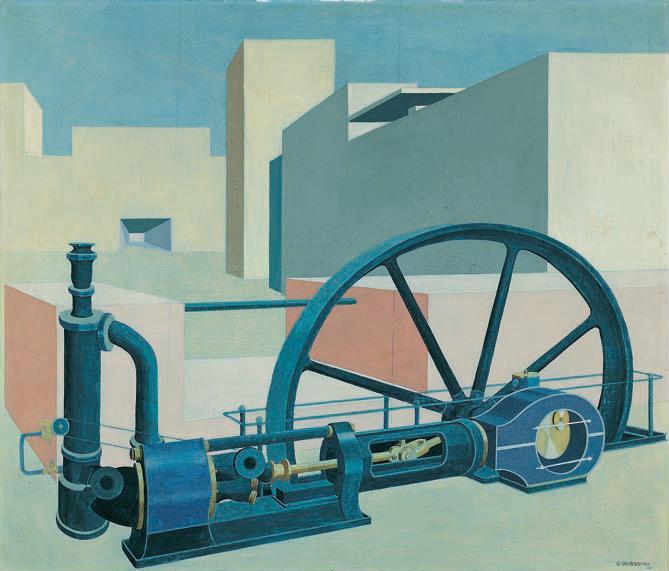
Art: Komposition mit Turbine by Carl Grossberg


Leave a Reply