The day an agent offers you representation is one of the most incredible moments in your publishing journey.
I’ll never forget when Catherine Drayton called me to offer representation for Jacob Wonderbar. I had doubted myself nearly every step of the way before that point, and hadn’t even told my friends and family I was working on a novel. But suddenly there was someone else who believed in my novel’s potential! A publishing professional, no less!
Since you’ll inevitably experience a rush of euphoria, it’s all the more reason to plan out your strategy for handling an offer from a literary agent ahead of time. Don’t immediately yell, “YES, DEAR LORD YES!” even if you really want to. Take your time to make sure it’s the right fit.
This is a crucial conversation. A bad agent (or a bad relationship with your agent) can do more harm to your writing career than having no agent. If an agent sends out your work to publishers, that’s your shot.
Having been on both sides of this phone call, as both an agent and as an author, here’s my advice for how to handle an offer of representation from a literary agent. These are the key steps:
- Thank the agent and set up a different time to talk
- Follow up with the other agents who have your work
- Triple-check that the agent is reputable
- Prep your list of questions
- Go with your gut
Also, I offer online classes with exclusive resources about finding and working with literary agents that you can take at your leisure. They will help you every step of the way!
And if you need personalized help, I can help edit your query letter or you can book a consultation to ask questions.
Thank the agent and set up a different time to talk
Even if your agent calls to give you the good news, sure, have a conversation with them, thank them for believing in you, but schedule another time to talk through the logistics.
You’ll probably need some time to mentally prep for the conversation, as well as to handle any necessary follow-ups with other agents who have your manuscript (more on that in a sec). Give them a time frame for the conversation that accounts for these follow-ups.
Don’t worry about putting off the full conversation. You’re not going to offend the agent. They expect that you’ll take some time to think it through and make sure it’s a good fit. (And if they’re putting pressure on you to decide, don’t necessarily run away, but be wary).
Also, don’t worry about the agent thinking you’re weird for being a blubbering, excited mess. They’ve seen it all (and they’re excited too).
Follow up with the other agents who have your work
If other agents have already requested your manuscript, it’s customary to give them a heads-up that you have received an offer of representation and give them a reasonable time frame (7-14 days) to consider your work.
Opinions vary a bit on whether to also follow up with agents who haven’t already responded to your query to request your manuscript. I don’t personally advise this, but some agents do expect it, and if you have a dream agent on that list, it’s not likely to kill your chances with the first agent if you are getting back to them in a reasonable time frame.
Regardless of what you decide, I definitely wouldn’t advise taking that offer from the agent and blasting out a million new queries to everyone else on your list. That’s not cool. Be respectful to the agent who jumped first. It’s a small industry and you’d be surprised what will get back to the first agent.
Also, follow through with outreach to other agents after an offer even if the agent who offered you representation is at the very top of your wishlist. You’ll benefit from the additional conversations even if you still go with the top agent on your list, and you’ll be more confident in your choice.
Triple-check that the agent is reputable
You should have already done this step when you researched your list of literary agents, but it couldn’t hurt to check again.
And make sure you know your rights as an author. Search for the agent in Writer Beware. Double-check the agent’s email address to make sure you’re communicating with the real person.
There are tons and tons of scams out there, and there are also schmagents who don’t even know they’re bad agents. It’s crucial to do your research and due diligence.
Prep your list of questions
It’s okay if you have a million questions. Take your time to make sure you’re comfortable.
Here are the questions I think are especially important to ask prior to accepting an offer of representation:
- What did they like about your book? This is such a simple but crucial question. Hopefully the agent already communicated this when they offered you representation, but if they didn’t: ask. Why? 1) If they’re faking their enthusiasm, you’ll know it (and if they’re a scammer or bad agent they’ll probably stumble through it) and 2) Their answer will help you make sure they “get” you and your book.
- What is their communication style? This one is super important. Agents vary greatly in their approach to the information they communicate to their clients and how often they communicate it. Some agents share everything, including all rejection letters. Some check in at periodic intervals and just share a summary. Some agents get back to you in 24 hours, some take a month or two. And some give their clients discretion over what they see. Try to suss out their style and make sure it works for you.
- Is there an author/agency agreement? Most agents (though not all) have author/agency agreements that you’ll need to sign in order to become a client. Make sure that you understand and are comfortable with everything in the author/agency agreement and that there’s a reasonable termination clause if things don’t work out. Note that most agents will have the right to receive commission for deals they initiated even if you then part ways (so you can’t get a deal and then just bounce on them to avoid the commission). Please note: I’m not an attorney and don’t construe this as legal advice. Consult a publishing attorney if you have any questions.
- What incidental charges will you be responsible for? Will the agent expect you to pay for additional services?Traditionally, agents only got paid when you get paid via commissions, except for some specific incidentals like photocopying and postage. Full stop. But the American Association of Literary Agents (AALA) recently loosened its Canon of Ethics to allow agents to charge clients for services, such as editing and marketing, and to collect affiliate fees, as long as there’s transparency. So the waters have gotten murkier. Make sure you know what charges will be expected and that you’re comfortable with them. Reputable agents should minimize your outside charges and will focus on earning their commission. Schmagents may dangle representation as an excuse to charge you fees for services you may not need.
- How many books have you sold to traditional publishers in the last two years where you didn’t have a financial interest other than commission? And/or, who is your mentor? The first question comes via Jane Friedman as a way to weed out schmagents. A reputable agent should have a solid roster of commission-only clients. Otherwise, if an agent has paltry sales, that might still be okay! Everyone has to start somewhere, and young agents apprenticing at established agencies may be hungry and go the extra mile. But get a sense of who their mentor is and who they can draw upon for support.
- What’s the normal time-frame for remitting advances and royalty payments? The author/agency agreement (as well as your eventual agreement with a publisher) will likely have a provision that will direct the publisher to pay the agency, who will then subtract your commission and pay you the balance. Find out how long this turnaround usually takes.
- Are they interested in you for just this book or for others as well? How will that work? This isn’t necessarily the time to pitch the agent on the seventeen manuscripts in your drawer, but you should understand whether the agent is interested in more projects from you no matter what happens with this particular book. They may well want to focus on this first one and see what happens, but find out how and when they want to discuss future book projects.
- Do they plan to only submit to the major publishers or will they submit until the bitter end? I’m a little hyperbolic with that last part, but this is really important. Bear in mind that an agent receives a 15% commission on any advance, and small presses may well only offer in the low $1,000s of dollars. Multiply $1,500 x 15%, calculate the hours involved in submitting a project for the agent, and you’ll see they’re lucky to crack minimum wage. Some agents are still willing to go to small presses in the hopes of building up an author over the long haul, others may want to stop at the majors. Make sure you’re satisfied with the agent’s approach.
- How does the agency handle subsidiary rights like audio and film? Some agents have in-house departments to handle film rights. Some work with outside agents. But make sure you understand how it works.
- Does the manuscript need any changes or are you good to go? Some agents are hands-on and will work with an author on revisions; others only take on projects they think are ready to go. Don’t be alarmed at either answer, but if they do want changes, make sure they’re consistent with your vision for the book.
- Can you talk to some of their other clients? I’d only recommend asking to speak to other clients if you are truly on the fence and feel like you really need to. When I was an agent, I didn’t agree to facilitate these calls. Not because I had anything to hide, but because I didn’t want to put my clients in the position of taking time out of their day to speak on my behalf. So if an agent declines, it’s not necessarily a sign they’re disreputable. And bear in mind that almost by definition, any authors an agent connects you with are likely to be happy with the agent and/or will be unwilling to speak ill of them. But if you feel you badly need this, you’re free to ask.
- Anything else that is important to you. Seriously. Now’s the time.
Go with your gut
Try to be as calm as possible for this conversation, be honest and transparent with everyone throughout the process, listen to what the agent (or agents) have to say, and the answer should become clear.
Trust your instincts! If something feels off, pull the thread, ask the tough questions, seek guidance from outside experts, and be prepared to walk away if it doesn’t feel right. You’re always welcome to book time to speak with me, and I can help you sort through what is customary publishing industry weirdness and what’s a potential red flag.
Definitely be clear-eyed, be diligent, be thorough, but don’t be paranoid either. There are wonderful literary agents out there, nearly everyone who works in publishing is there for the love of books and the creative process, and it’s a great sign that someone wants to invest in you.
There’s something magical about finding an advocate who believes in your work. Your team just got much bigger.
For a more lighthearted take on this process, check out The Publishing Process in GIF Form!
Need help with your book? I’m available for manuscript edits, query critiques, and coaching!
For my best advice, check out my online classes, my guide to writing a novel, and my guide to publishing a book.
And if you like this post: subscribe to my newsletter!
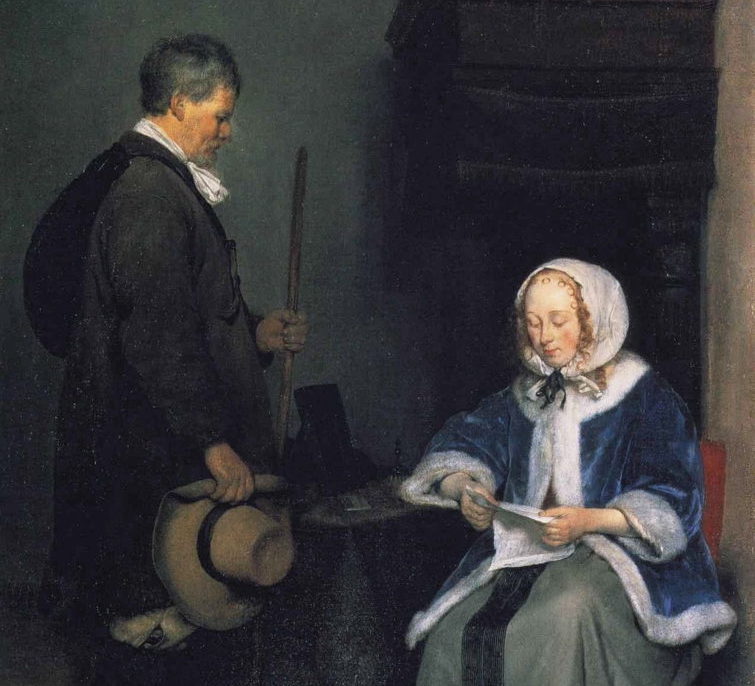
Art: Detail of A Lady Reading a Letter by Gerard ter Borch



A challenge heartily to be desired! Thanks for this informative view from both sides of the fence, Nathan.
I found your article very interesting. I am wondering (since I write mostly nonfiction for the Christian market), if the points in the article would apply to nonfiction? Would there be any points that need to be added?
Thanks!
Janis
I can’t think of anything that would be different.
What do you mean by going to small pressed to “build up the agent over the long haul”? Can you please flesh this out? Thank you! Great article!
correction: I meant to flesh out “build up the author”…
Small presses can potentially be a great avenue for authors to find their niche and some go on to be nominated for awards and things like that and build their audiences through time. A literary agent in it for the long haul could see a small press deal as an investment that could reap dividends down the line as an author’s career builds (or they might just be happy to try to do right by the author even if it’s not totally lucrative).
Thank you for this. I was worried small presses wouldn’t have the oompf in getting the book out on the market in the ways a larger press would. But, shall I understand that small presses have the same influence in getting the book to independent bookstore, chain book stores, and online retailers in the same way as large presses?
I definitely wouldn’t necessarily say “the same” influence, and it varies a lot from publisher to publisher. But there are definitely small presses who have strong relationships and reputations with bookstores and can give an author a lift. There are other small presses who don’t do that much more for an author than they’d be able to do on their own. It really depends.
Thank you for sharing your inside info, Nathan. This is really helpful. I so agree that the right agent is important. The same applies to a publisher. Maybe that’s another blog! Warm blessings.
When an offer of representation is made, do you recommend sending a courtesy email to only queried agents who have requested additional materials (partial/full) or also to those who have recently (in the last 4 weeks) been queried but have yet to reply? Thank you in advance!
I think I address this in the post?
HA, you sure did. Sorry! Hadn’t had my coffee yet. Great post 🙂
When updating agents about another’s request for a full MS, do you need to name the requesting agent or not? Just wonder how they know you do have a legitimate request for full MS otherwise… Thanks!
I’m a bit confused by the question because I don’t recommend updating other agents on a request for a full manuscript?
Hi Nathan. Some UK agents state on their website to update them with “any interest or offers of representation” and I just wondered what the etiquette was about naming other agents. Thanks.
I think it’s customary to update when there’s an offer of representation, but not that there’s been another manuscript request.
In terms of telling them who the other agent is, it’s up to you. I don’t know that I’d proactively offer them the information, but it’s okay to tell them if they ask.
Are you a literary agent yourself Nathan? If a book was rejected in the past by publishers but has been completely re written since does it have a chance to be published through an agent and must we inform the agent that it has been rejected in the past?
Hi Nathan – I found everything you’ve written very interesting and helpful, but I do have one question. I’ve noticed there are some agents who request or state that they’re not interested in books or authors who have sent queries to numerous agents, and who want to be given a certain period of time for exclusivity on the opportunity to represent you. This seems pretty limiting, and not very realistic for new authors who are looking to find a good agent and get their work published. Should an author really sit back for at least a month until they receive a response from this agent, (or no response at all) they have sent a query letter to? That doesn’t seem like a wise choice for a new author, or a fair request from an agent. What do you think? Thanks for you info and help! Linda
I cover that in this post: https://nathanbransford.com/blog/2008/08/exclusives-and-literary-agents
Requesting an exclusive at the query stage is really odd and I probably wouldn’t go with any agent who has that requirement. It’s a bit more common at the manuscript request stage, but you’re within your rights to say no. The only time I personally think it’s really warranted is if the agent is working with you on a revision and investing time in your work. But otherwise, I think it’s poor practice on the part of the agents.