The best books are ones that disappear in our hands. When we’re reading a novel we love, we enter a fugue state and can’t turn the pages fast enough. The outside world disappears, and we get lost in lands we would never otherwise explore.
But we can’t get into that flow if the hand of the author is too apparent. When we’re forced to imagine the writer behind the words, remembering the artifice pulls us out of the world of the novel and breaks the delicate spell.
Writing a novel is a game of artful specificity. On the one hand, you must give the reader the exact right information and avoid losing sight of what is and isn’t on the page. On the other hand, if you overdo the details, the reader starts to feel restricted and unable to lose themselves in the page.
Here’s one important principle to follow to get this alchemy right. Be specific, yes, but don’t over-engineer how a reader “hears” your novel.
You probably don’t need that dramatic pause
One common writing tic I see often in my editing work with authors: Conversations that are constantly interrupted with dramatic pauses, empty gestures, ellipses, and other “beats” that are meant to control how the reader hears the dialogue.
I’ll see entire long conversations unfold like this one, where nothing much is gained by the interruptions:
“You see,” Nathan said, scratching his chin. “I… Well, you see…” Nathan cast his eyes at the person he was speaking to. “I probably…”
“Yes?” the person asked, leaning forward. “Go on.”
“Well,” Nathan said, waiting another beat for good measure. “I probably… Well, I probably could have just gotten on with it in the first place.”
Don’t over-engineer the rhythm of your dialogue! It takes the reader out of the moment and makes a conversation feel choppy. The hand of the author feels far too apparent.
Sure. Dramatic pauses can add some anticipation, but use them very sparingly and strategically. Only when it’s within character for someone to be dramatic, and even then only when it’s really, really necessarily.
For regular conversations: don’t overthink the rhythm. You hear the dialogue one way. Let the reader hear it their own way.
Only use italics if the emphasis changes the meaning of a sentence
I want to be clear that there aren’t hard and fast rules here. You the author have discretion over whether and when to use italics, as well as forms of emphasis like capitalization and exclamation points.
But personally? I avoid italics unless the sentence wouldn’t make sense otherwise. And get rid of capitalization and exclamation points. (Caveat: exclamation points in dialogue are okay, but use them sparingly).
Particularly when adults are writing children’s books, they have a tendency to imitate their (very adult) perception of teenagers’ dramatic way of emoting. When they then go to write fiction, they turn the teen voice into a string of exhortations that swiftly becomes extremely exhausting:
“Oh my GOD,” the fictional teenager said. “Can you believe adults write teenaged characters like THIS?! Do you really think teenagers see themselves as HOPELESSLY EXCITABLE individuals or think the reader’s not going to get the POINT if you just write the dialogue NORM. A. LLY?? Would YOU want to get stuck in an elevator for SIX HOURS with someone who talks like THIS???”
Yeah.
But there are exceptions! If, for instance, the emphasis fundamentally changes the meaning or implication of a sentence, go for it. Italicize away:
“I didn’t think you were going to the party with him” and “I didn’t think you were going to the party with him” convey two pretty different connotations. (Even then I would first try to avoid the italics with stronger voice, e.g. replacing the second version with “I didn’t think you were going to the party with Mr. Pissy Pants.”)
If, however, you’re merely trying to convey excitability, you’ll wear the reader out very quickly.
A little bit of an accent goes a long way
I like to compare accents and dialects in a novel to spices in cooking. The right amount can add some flavor. Too much will spoil the dish.
When it comes to accents, you only need a hint here or there to put the reader in the right mindset to “hear” the accent. Too much and you’ll interfere with basic readability.
“Aye, he’s a wee rogue isn’t he?” is sufficient to convey a Scottish accent, and henceforth the reader will carry that accent forward in their heads. You don’t need to try to write that all of that character’s dialogue completely phonetically like “Ayeh, hee’s a wee rogugah isna he?”, which is going to leave your reader staring at the sentence for 30 seconds more trying to figure out what it means.
Sure, there are classics like A Clockwork Orange by Anthony Burgess that liberally employ dialect and slang, and phonetic dialogue like The Adventures of Huckleberry Finn by Mark Twain.
Every writer has to write for their time. Modern vogue in most commercial fiction (including literary fiction from the major house) leans toward readability and being mindful of how dialogue from underrepresented groups is presented.
Let dialogue tags disappear for the reader
Some authors focus too much on dialogue tags to convey the meaning of spoken words, rather than letting the dialogue itself do the talking. Such as:
“I can’t do that!” Sarah ejaculated.
Put down the thesaurus. You don’t need to come up with variations of “said” and “asked” in order to vary up dialogue tags or to be overly precise about how a character speaks their words.
This is totally fine:
“I can’t do that!” Sarah said.
I’m guessing you “heard” Sarah’s words the exact same way regardless of the tag was “ejaculated” or “said.”
To be clear once again, there aren’t hard and fast rules here. There are some mega-bestsellers who go totally hog wild with dialogue tags. But modern convention at the Big 5 publishers tends toward letting the dialogue tags disappear for the reader.
Stick to said and asked as much as possible, with only a handful of exceptions.
Go easy on onomatopoeia
Sometimes, in an attempt to be dramatic, writers go wild with formatting and capitalization pyrotechnics in a way that is rarely, if ever, necessary. For instance:
There was a KNOCK! at the door. BANG! BANG! went the knocker.
You shouldn’t need to assault the reader’s senses like this. If you’ve primed the reader to feel suspense, the drama of the knock should announce itself:
There was a knock at the door. Bang went the knocker.
I’m guessing you didn’t “hear” the knock or bang in the second sentence any differently than you did the first. Trust the reader to grasp the drama.
Can you think of other times when writers you read went a little too hard over-engineering their prose and/or dialogue? Take to the comments!
ORIGINALLY PUBLISHED: “You probably don’t need that dramatic pause” on April 7, 2020
Need help with your book? I’m available for manuscript edits, query critiques, and coaching!
For my best advice, check out my online classes, my guide to writing a novel, and my guide to publishing a book.
And if you like this post: subscribe to my newsletter!
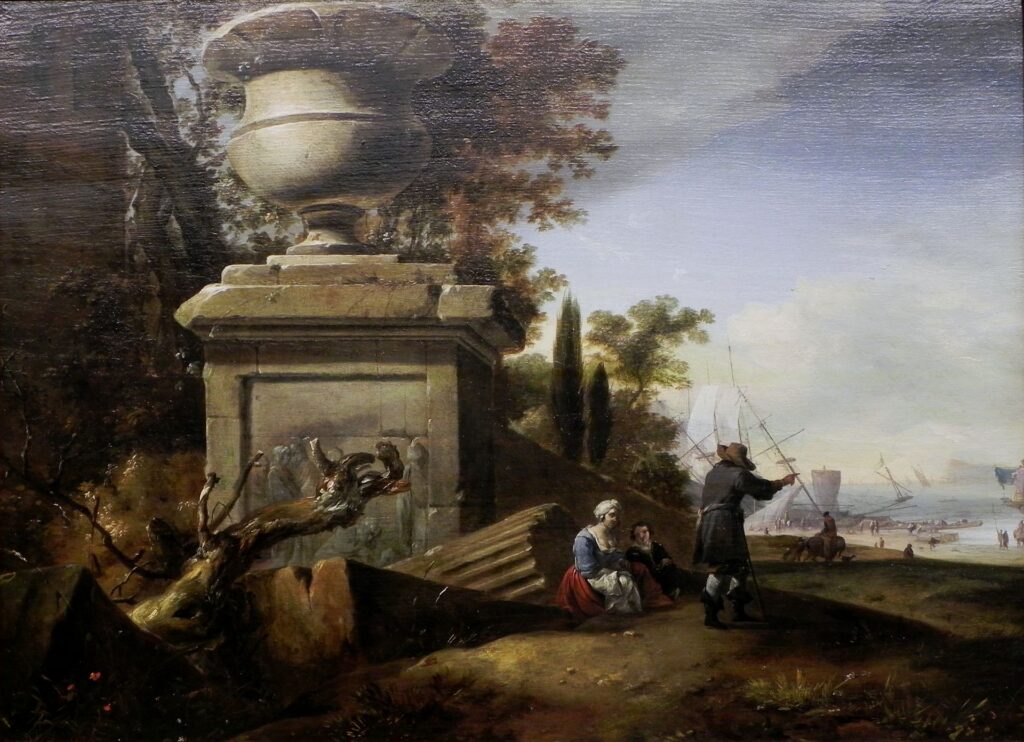
Art: Ein Gespräch am Sockel einer steinernen Vase by Jan Weenix


“Hmmm…maybe…on the other hand…perhaps…” John mused idly.
But seriously, I actually prefer the other extreme, as in Michael Crichton’s later novels, which have so little in the way of dialogue (and particularly duologue) tags and attributions that parts of them look like movie scripts.
I agree. I do law enforcement transcription and even though that’s how people speak, it’s infuriating to listen to much less to try to read on a page.
But when I started writing I couldn’t write a sentence without an ellipse. I’ve broken myself of that habit…more or less.
Thanks for this, Nathan. My current WIP, a memoir, is dialogue heavy – which is probably the wrong thing to have done – and at first used a lot of the pauses, etc. you mentioned. I’ve been whittling it down but think I still need to do more. What has been difficult for me is portraying a telephone conversation that I witness. I can only hear the person in the room and not the person she is talking to. How to get that across has been a real challenge. I wish I knew of a book that has something like that so to get a better idea of how best to do it. I thought of doing it this way, but didn’t: “I said to Mama that I checked myself out of the hospital and then she said, ‘I wish you would have told me first’ and then I said that I’m an adult, and besides there was no phone in the room and then she said ‘ Do you want your sister to come get you?’ and then I said, ‘No. I can take care of myself.'” You get the idea. Too ponderous.
Thanks for letting me laugh at myself. Time to edit.
Publishers of middle grade books really need to hire middle school teachers to consult. Then we could flag every use of “ejaculated” and a whole list of other words that immediately derail a whole class when read aloud.